Ohenro as a Gift: Why Walking Shikoku for Someone Has Become the Most Meaningful Present You Can Give
You want to do something meaningful for a parent while they’re still well enough to appreciate it.
But nothing on a normal gift list feels quite right.
If that’s where you are, you’re not the only one.
Here’s something most people outside Japan don’t know: Ohenro itself can be given as a gift.
Someone walks the 88 temples of Shikoku on behalf of the person you want to honor, and what you give them is the record of that walk.
It’s an experience gift and a keepsake at the same time — a shape of present that doesn’t really exist in any other category.
- Why Ohenro works as an “experience gift” — and the 1,000-year history of daisan behind it
- The three things the recipient actually keeps: the nokyocho, goshuin stamps, and the byakue robe
- Who this gift lands well with, and the moments people choose it for
- How it differs, on a fundamental level, from any other gift you could give
By the end, giving Ohenro as a gift should sit next to your other options as a real, serious candidate.
Yes, You Can Actually Give Ohenro as a Gift: A New Kind of Experience Present
Let’s start with the basic premise.
Ohenro works as a gift. It’s not a stretch.
“Wait — isn’t Ohenro something you walk yourself?” That’s usually the first reaction.
Here’s the thing. Shikoku has a centuries-old tradition called daisan (代参) — proxy pilgrimage, and it’s been part of the culture for more than a thousand years.
Daisan means having someone else walk the pilgrimage on your behalf. Back in the Edo period, entire villages would pool money so one strong walker could carry the prayers of the whole community around all 88 temples.
“I can’t go myself, but I still want the prayer delivered” — that wish gets handed off to someone who can.
So this isn’t a modern workaround. It’s an option baked into Ohenro culture itself, with deep roots.
- Daisan is a proxy pilgrimage tradition going back to the Edo period
- The Shikoku Reijokai (the official association of the 88 temples) accepts proxy visits
- “Experience gifts” are now a normal category — Ohenro fits naturally inside it
- Instead of an object, you’re giving a prayer and a record — which older generations especially understand
On top of all that, experience gifts — travel, spa stays, fancy dinners — have become a normal part of how people give these days.
Ohenro fits inside that trend, but with more weight to it. It’s an experience gift with real meaning, and one that leaves something physical behind.
If the daisan tradition itself is new to you, our deeper piece on what proxy pilgrimage actually is covers the history in more detail.
Why Ohenro Actually Works as an Experience Gift
“But does it really work as a gift, though?”
Valid question.
There are three elements that make Ohenro work as an experience gift.
- The experience itself: walking and praying at 88 temples — a once-in-a-lifetime stretch of time
- Things that physically remain: the nokyocho, goshuin stamps, and byakue robe — real objects the recipient gets to hold
- A story: who walked, for whom, and with what intention — the context behind every stamp
Most physical gifts give a short burst of happiness and then fade. Ohenro as a gift is different — time, record, and story all stack on top of each other.
Which is why it tends to stay in the recipient’s memory much longer than a regular present.
“Once in a lifetime” is actually a phrase that fits this one pretty well.
The Nokyocho as the Gift: Why the 88-Temple Stamp Book Is the Heart of It
The single most important part of Ohenro as a gift is this: the nokyocho arrives in the recipient’s hands.
The experience doesn’t just happen and vanish. Something tangible stays.
That’s what sets this apart from every other experience gift.
A nokyocho is a book filled with hand-brushed calligraphy and stamped seals, one pair per temple, collected directly at each of the 88 sites.
Open it and you see the temple name, the honzon (principal deity), and the vermilion seal — laid out in the exact order the pilgrimage was walked.
One book, 88 temples’ worth of prayer, bound between two covers.
- Each page is hand-written on the spot, so no two nokyocho in the world are identical
- The walker carries the recipient’s name and intention while receiving each stamp
- Many families keep it on a home altar or tokonoma and touch it daily — it’s not a drawer item
- Older Japanese generations instantly understand the value of a “real” nokyocho
Temple stamp fees were revised in 2024 to 500 yen per temple, which comes to 44,000 yen across all 88 temples (roughly $300 USD).
Seeing that number makes it concrete: the nokyocho is a physical accumulation of prayers collected on-site, not a souvenir.
And the craft side of it matters too.
Each temple has its own person doing the calligraphy, usually a monk or a designated staff member trained in it. They brush the characters in real time, in front of you, with a writing technique passed down for generations.
Two vermilion seals get pressed on top of the ink — one for the temple, one for the honzon. The red against the black is what makes nokyocho pages so visually striking when you flip through the book.
And because every calligrapher has their own hand, the same temple’s page looks slightly different in every nokyocho on earth. There’s no other stamp book with that property.
Which is why, when someone opens the cover for the first time, there’s usually a pause before they say anything. It’s not a “thanks, this is nice” kind of gift.
If you’re curious how a nokyocho differs from a regular goshuincho (shrine stamp book), our comparison piece breaks down the distinctions.
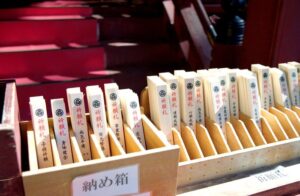
What the Nokyocho, Goshuin, and Byakue Actually Mean as Keepsakes
The nokyocho isn’t the only thing the recipient keeps.
Let’s look at all three.
- Nokyocho: the 88-temple stamp book — calligraphy and vermilion seals side by side. The core of the gift
- Goshuin: the individual vermilion seals stamped with black ink calligraphy at each temple — proof of devotion at each site
- Byakue (read: byakue): the white pilgrim’s robe worn throughout the journey. With all 88 temple seals stamped on it, it becomes a lifelong memorial object
The byakue in particular lands hard with older Japanese recipients. It reads immediately as “someone did the real thing for me.”
A white robe lined with 88 red stamps has a presence that’s hard to miss. You can tell at a glance it wasn’t mass-produced.
On the receiving end, the nokyocho becomes something the person can revisit for the rest of their life.
The big contrast with consumable gifts: once given, it stays.
One more thing worth saying about the byakue.
In traditional Ohenro, the white robe is treated as something that belongs with the person for the rest of their life. The common understanding is that it’s the garment they’ll eventually be buried or cremated in.
That part tends to land quietly with older recipients. It’s not something you’d put on a greeting card. But it explains why a byakue fully stamped with 88 seals carries a weight that’s almost impossible to match with any other object.
You’re not giving “a souvenir from a trip.” You’re giving something they’ll keep with them permanently, in the deepest sense of the word.
Who’s This Actually For? The People and Moments It Lands Best With
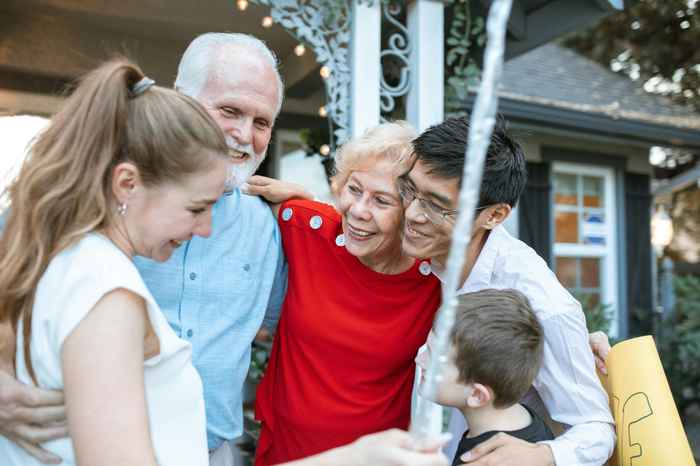
The next natural question: who is this gift actually for?
Ohenro as a present isn’t a universal gift. It doesn’t land well with just anyone.
It’s one of those gifts where the recipient and the occasion really matter.
- Aging parents in their parents in their 70s or 80s, especially ones who once mentioned Ohenro
- Parents hitting a milestone year — 60th, 70th, 77th, or 88th birthdays are common in Japan
- Family members who live far away, where distance makes ordinary gifts feel insufficient
- Relatives recovering from illness, where the pilgrimage itself is out of the question but a prayer is welcome
- Memorial occasions — when a parent passed without walking the Ohenro they talked about
What connects all of these? “I can’t get to Shikoku myself anymore, but the pull toward Ohenro is still there.”
Age, health, distance, time — real-world constraints make the trip itself impossible.
In those situations, people pick this as the other option: have someone walk on their behalf and receive a nokyocho at the end.
For aging parents specifically, our piece on Ohenro options by age and physical ability lays out the full picture alongside this one.
Why Aging Parents, Milestone Years, and Distant Family All Fit
Let’s go one level deeper into each of these.
The generation now in their 70s and 80s grew up with Ohenro carrying real cultural weight. Many of them quietly gave up on the idea years ago — “I would’ve liked to, but at this point, no.” When a nokyocho shows up with “I walked it for you” attached, the reaction is often one that doesn’t fit into words.
Ages 60, 70, 77, 88 are all culturally significant in Japan, and they’re exactly the moments where people look for a present with actual meaning instead of the usual fare. Regular gifts repeat every year. Ohenro carries once-in-a-lifetime weight — which lines up well with once-in-a-lifetime occasions.
Distance tends to intensify the urge to send something meaningful. We hear this constantly from adult children who moved out of prefecture or out of Japan: “I can’t be there in person, so at least let me send something that matters.” Ohenro as a gift is built to carry feeling across distance, which is exactly the shape that situation needs.
Under all of these is the same feeling: “do something while there’s still time.”
That’s what separates this from other gift categories, in my experience.
How Ohenro Differs from a Regular Gift: Why a Once-in-a-Lifetime Experience Actually Lands
At this point you might be thinking:
“Okay, but how is it actually different from a normal gift?”
Important question. Let’s lay it out cleanly.
Regular gift vs. Ohenro as a gift
| Dimension | Regular gift | Ohenro as a gift |
|---|---|---|
| What remains | Gets used up or loses its shine | The nokyocho stays with them for life |
| Shared experience | Handed over, that’s it | You share the walking period too — live video, updates |
| Story behind it | Just the reason you bought it | Who walked, for whom, and where — all recorded |
| Fit for older recipients | Hit or miss, depends on taste | Resonates deeply with the Ohenro-aware generation |
| Repeatability | Can be given year after year | Carries once-in-a-lifetime weight |
The big one is this: “experience” and “something physical” overlap.
A travel gift gives experience but leaves only memory.
A plate or a sweater has physical form but no story of time spent.
Ohenro as a gift is one of the rare categories where both exist simultaneously.
Let me give a concrete comparison.
Say you send your mother a high-end tea set for her birthday. She’ll use it, probably enjoy it, maybe display it when people come over. Two years later, the set is still nice but the birthday itself has faded in memory.
Now say you send her a nokyocho walked in her name. She opens it, turns the pages, reads the hand-brushed kanji for each temple. Two years later, she’s still pulling it out on her meinichi (memorial days) or when relatives visit, and the story of “my son had this walked for me” is still attached to it.
The tea set stayed material. The nokyocho keeps getting reopened.
That’s the practical difference people usually describe after the fact.
Of course, choosing the right way to actually deliver this matters — our guide on choosing an Ohenro proxy service walks through the checkpoints.
When “Being Prayed For” and “Something You Can Hold” Meet
Let me get a little more emotional here.
When someone chooses this gift, what are they really purchasing?
If you push it all the way down, they’re buying “time during which someone is praying for them”.
You’re giving “time spent praying” as the experience side.
And you’re giving the “nokyocho” as the physical side.
These two overlapping is the whole point of Ohenro as a gift.
And there’s one more layer most givers don’t realize upfront: the shared experience of the walk itself.
With modern proxy services, the giver gets to follow along. Live video from the temples, GPS tracking of the walker’s route, photos at each of the 88 sites. So for the two to three weeks the pilgrimage is happening, the giver is also quietly participating — checking the map before work, watching a stream at night, seeing which temple was reached today.
That period turns into its own small ritual for the giver. A lot of the people I work with tell me the walking period itself ended up being meaningful for them, not just the nokyocho arrival at the end.
So the gift isn’t only “a nokyocho shows up one day.” It’s a stretch of days during which both the giver and the receiver are oriented around the same thing.
That’s the part that tends to stay in the family story for years afterward.
If you’re approaching this from the angle of “I want to do something meaningful for my parents while I still can,” our piece on meaningful gratitude gifts for aging parents is a good companion read.

Common Questions About Giving Ohenro as a Gift
- Will my parent actually appreciate it as a gift?
- How much is a nokyocho actually worth?
- Can I give it as a surprise?
- Is it a good fit for milestone birthdays?
- Does it work for a parent who lives far away?
Ohenro as a Gift: Turning Gratitude You Can’t Put Into Words Into Something Real
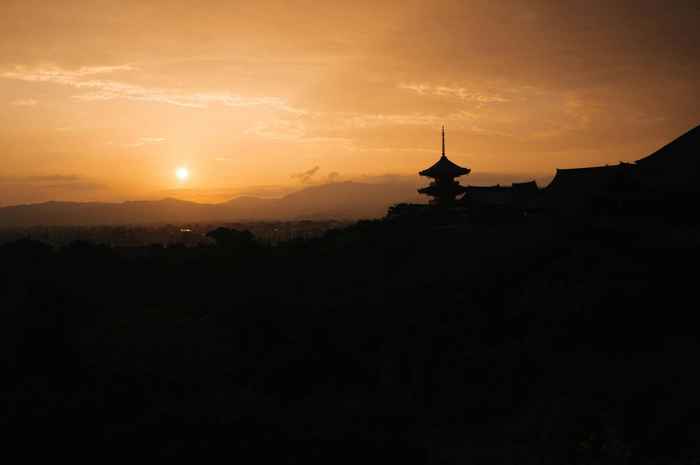
So that was the full picture of what it looks like to give Ohenro as a gift, from multiple angles.
Looking back, the main points are simple.
- Ohenro works as a gift because of daisan — a 1,000-year-old proxy pilgrimage tradition
- The recipient receives physical keepsakes: the nokyocho, goshuin seals, and byakue robe
- It tends to be chosen for aging parents, milestone birthdays, and family across distance
- Unlike regular gifts, “experience” and “something physical” both exist at once — a rare category
- At its core, you’re giving someone “time during which they were being prayed for”
When a physical object feels too thin, and just words feel too light.
It’s worth knowing that giving Ohenro as a gift exists as an option — even just holding onto that for later.
One thing I’ve noticed over the last few years: the people who end up choosing this gift usually aren’t looking for “a unique present.” They’re looking for a way to handle something specific.
A parent they haven’t spent enough time with. A milestone year coming up. A sense that the window for doing something meaningful is narrower than it used to be.
Ohenro as a gift doesn’t solve any of that — I want to be honest about that. It isn’t magic.
But it gives the feeling somewhere to go. A shape. A record. A walk that actually happened, in the recipient’s name, at 88 real temples on a real island.
For a lot of people, that’s exactly what they needed the gift to be — without having the words for it ahead of time.
- Real walked Ohenro: all 88 temples on foot, not skipped or driven
- Live video and GPS tracking: the giver can see where the walker is, in real time
- A real nokyocho: calligraphy and seals collected in person at each of the 88 temples
- Pilgrimage reports: a written record of which temples received which intentions
- Free consultation: we’ll help you decide on a plan and how to present it to the recipient
You don’t have to decide right now.
Honestly, just knowing “this kind of gift exists” is enough for today.
If you want to look at it more concretely, our plans and pricing page lays it all out — cost, timelines, how to frame it to the recipient. We handle the rest through a free consultation.
▼Related reading
- Nokyocho vs Goshuincho: What Sets the Shikoku Pilgrimage Stamp Book Apart
- Meaningful Gifts for Aging Parents: How to Show Gratitude Before Words Run Out
- Ohenro After 70: Can Seniors Walk the Shikoku Pilgrimage? 4 Ways to Visit by Age & Stamina
![[Ohenro]Shikoku Pilgrimage Proxy Service: Costs and How to Choose a Trusted Provider](https://ohenro-gift.com/en/giftohenro369/wp-content/uploads/2026/03/agency_thumb-300x200.jpg)