
What Is Ohenro? Meaning, Purpose & the Shikoku 88 Temple Pilgrimage
Why do people do it?
Does religion or Buddhist sect matter if you want to take part?
I’d love a simple explanation.
In this article, I’ll answer those questions and explain what Ohenro really is in the clearest and simplest way possible.
What You’ll Learn in This Article
- What Ohenro means, why people do it, and what its purpose is
- Whether Ohenro is connected to a specific Buddhist sect
- The origin, background, and history of Ohenro
- What “osettai,” one of the best-known customs of the pilgrimage, actually means
This article will walk you through the history, meaning, and spiritual background of Ohenro in an easy-to-understand way. If you’ve ever wondered, “What is Ohenro?” you’ll find the answer here.
What Is Ohenro?
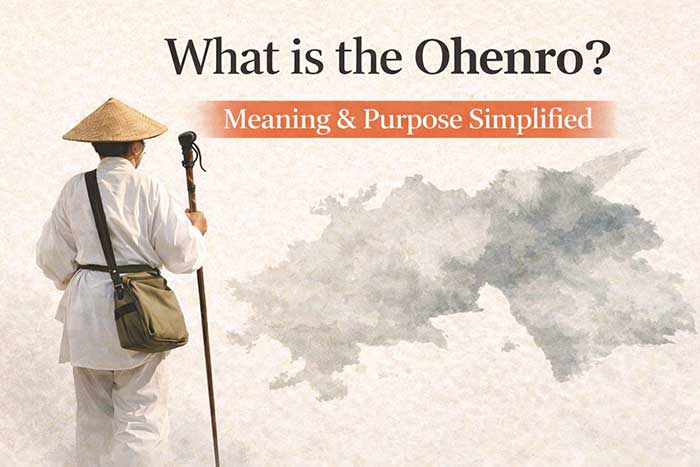
Ohenro is a pilgrimage around the 88 temples in Shikoku associated with Kobo Daishi, also known as Kukai, visiting them one by one in order.
Ohenro has continued for centuries and has been passed down in Shikoku as a deeply rooted part of everyday culture.
You may have heard the name before, but at the center of this tradition is Kukai—also known as Kobo Daishi—a revered Buddhist monk from long ago.
Ohenro as a Living Tradition
Ohenro has a traditional form that has been preserved for generations, and at its core, it is quite simple.
- Visit the 88 temples of Shikoku in sequence
- Follow proper etiquette and offer your prayers at each temple
- Pray for yourself or your family, express gratitude, or make the journey in remembrance of someone
These three elements have long been at the heart of Ohenro as a tradition.
Ohenro is also known by several other names.
- Ohenro Pilgrimage
- Shikoku Henro
- Shikoku Pilgrimage
- 88 Temple Pilgrimage
- Shikoku 88 Temple Pilgrimage
- Pilgrimage to the 88 Sacred Sites
- Temple Pilgrimage
As you can see, the tradition is referred to in different ways depending on the person.
In short, Ohenro is an age-old pilgrimage in which people visit the 88 temples of Shikoku associated with Kukai (Kobo Daishi).
And within each step of that pilgrimage lives a long-inherited culture of prayer and gratitude.
What Do “Ohenro-san” and “Ohenro-sama” Mean?
“Ohenro-san” is a warm, familiar way of referring to someone making the pilgrimage around the sacred temples of Shikoku.
On the other hand, “Ohenro-sama” is a more respectful and formal expression.
You will often hear it in the context of osettai, or when older locals speak to pilgrims with particular reverence.
In everyday conversation, “Ohenro-san” is more common, but both are respectful ways to refer to a person on pilgrimage.
What Is the Meaning and Purpose of Ohenro? Why Do People Do It?
Why do people choose to do it?
The most common reasons people take part in Ohenro include the following:
- Prayer: wishes for health, family happiness, success in work, exams, and other hopes for the future
- Memorial devotion: expressing gratitude to someone who has passed away and finding inner peace through prayer
- A turning point in life: marking a new chapter such as a job change, divorce, graduation, moving, or recovery
- Finding yourself again: restoring balance to a life or heart that has become exhausted or unsettled
At its core, Ohenro is a pilgrimage in which people visit the 88 temples of Shikoku while praying, remembering loved ones, and reflecting on their own hearts.
So if someone asks, “Why do people do Ohenro?” the honest answer is that there is no single reason. It depends on the individual.
In recent years, some people have also joined the pilgrimage simply because of the temple stamp boom, thinking of it as a way to collect goshuin stamps. And that, too, can be one reason someone begins Ohenro.
The Most Common Reasons: Prayer, Memorial, and Life Transitions
People walk Ohenro for many different reasons, but the three most common are prayer, memorial devotion, and major life transitions.
For those who walk in prayer, the journey is made with hopes for personal health, family happiness, or success in work and life.
For memorial purposes, Ohenro becomes a memorial journey of gratitude for someone who has passed away, or a way to calm one’s own heart.
In Shikoku, some even say that this form of memorial devotion can feel stronger than an ordinary visit to a grave or family altar.
As a life transition, Ohenro is often chosen to mark a life milestone or turning point—after changing jobs, moving, heartbreak, divorce, or illness recovery.
What all of these motivations share is this: walking, praying, and visiting temples helps people sort through their feelings and take the next step forward.
As a side note, there are stories that when Kukai himself traveled through Shikoku, he was performing ascetic practice and even guiding temples in the region toward Shingon Buddhism. Some legends even say that he was spiritually protecting Shikoku itself.
How much of that is literal truth is impossible to say, but one thing is clear: the meaning and purpose of Ohenro can differ from person to person.
What Buddhist Sect Is Ohenro Connected To? Can People from Other Backgrounds Join?
Many people wonder:
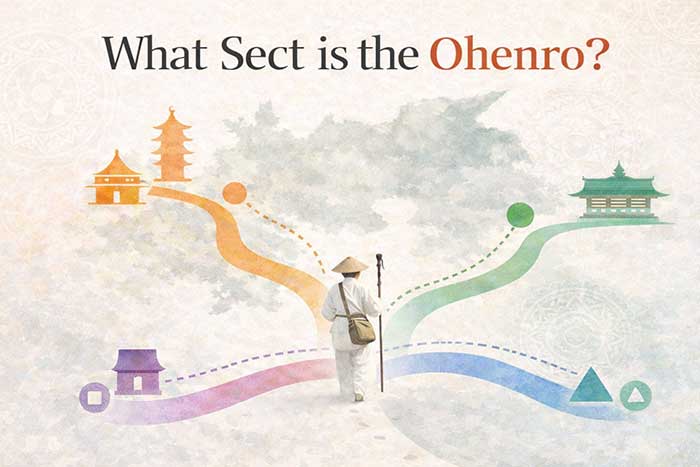
“Which Buddhist sect is Ohenro connected to?”
“Can I still take part if I follow a different religion—or none at all?”
The short answer is this: because Ohenro is rooted in the path of Kukai (Kobo Daishi), it has a strong foundation in Shingon Buddhism.
But in practice, Ohenro is not a place where people compete over the depth of their faith.
That means Ohenro is religiously open to people from other sects, other religions, or no religion at all.
From here, I’ll explain clearly:
why Shingon Buddhism is seen as the foundation,
how to think about Ohenro if you come from another background,
and why some of the temples on the route actually belong to other sects.
At Its Core, Ohenro Is Rooted in Shingon Buddhism Founded by Kukai
As mentioned above, the main religious foundation of Ohenro is Shingon Buddhism.
According to the Shikoku 88 Temple Association, the 88 sacred sites of Shikoku were established around 1,200 years ago in connection with Kobo Daishi (Kukai), the founder of Shingon Buddhism.
So when people ask which sect Ohenro belongs to, Shingon Buddhism is the spiritual foundation.
In Fact, Not All Temples on the Route Belong to Shingon Buddhism
Although many people assume that all Ohenro temples are Shingon temples, the 88 temples actually include some from other sects as well.
Sects Other Than Shingon on the Route
- 4 Tendai temples
- 2 Rinzai temples
- 1 Soto temple
- 1 Ji-shu temple
Historically, the route may have been even more diverse, and some temples are believed to have changed sect affiliation over time.
No—not really.
Even when the temple belongs to a different sect, the basic pilgrimage etiquette remains the same, so there is usually no need to worry about each temple’s sect while doing Ohenro.
You Can Join Ohenro Even If You Follow Another Religion—or None at All
Some people worry, “Is it okay if I’m from another faith, or not religious at all?” The answer is yes—absolutely.
At its heart, Buddhism does not turn people away.
The Japan Heritage Portal of the Agency for Cultural Affairs describes the Shikoku pilgrimage as:
The Origin and History of Ohenro: What Is the Relationship Between Kukai and the Pilgrimage?
The origin of Ohenro is traditionally linked to the sacred places of Shikoku associated with the spiritual training of Kobo Daishi Kukai.
Because Kukai was born in what is now Kagawa Prefecture in Shikoku (then known as Sanuki Province) and is said to have trained there, Shikoku became the land of this pilgrimage, and that tradition continues to this day.
According to the Agency for Cultural Affairs, the roots of the pilgrimage go back to monks and ascetics of the Heian period. By the Kamakura period, famous figures such as Saigyo, Honen, and Ippen are also said to have visited Shikoku, and over time the pilgrimage spread to ordinary people as well.
Later, during the Edo period, improved travel routes made long-distance pilgrimage more accessible, and Shikoku came to be seen as a sacred place—firmly establishing Ohenro as part of Japanese culture.
The “88 Temple Pilgrimage” Means Visiting All 88 Sacred Temples
Another common name for Ohenro is the 88 Temple Pilgrimage. The name comes directly from the act of visiting the 88 sacred temple sites spread across Shikoku.
The Basic Way of Thinking About the 88 Temples
A core idea of the Shikoku 88 Temple pilgrimage is that all 88 temples form one connected pilgrimage path, and every temple matters.
That is why many people take the approach of visiting temples at their own pace, whenever they can, over the course of a lifetime until they complete the full circuit.
What Does Ketsugan Mean?
Ketsugan is the word used when a pilgrim has successfully visited all 88 temples of the Shikoku pilgrimage.
It carries the sense of “bringing one’s vow to completion,” marking the end of the pilgrimage.
You may also hear the term Mangan, which is another word used for the same idea.
Once all 88 temples have been completed, some say that your prayers may finally come to fulfillment as part of completing the vow.
What Does Dogyo Ninin Mean? “Even Alone, You Are Not Truly Alone.”
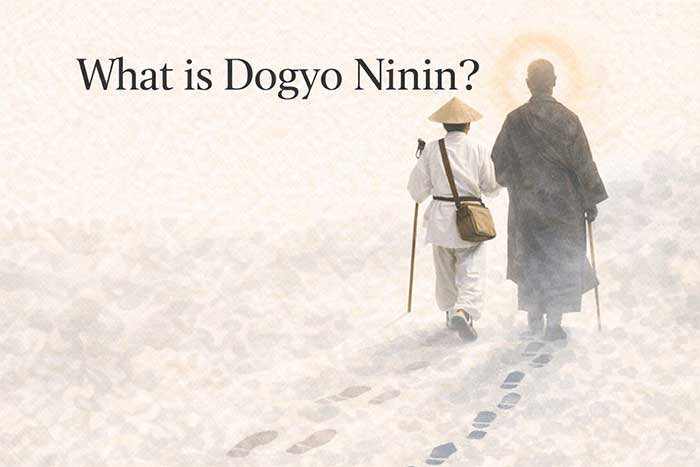
There is a phrase that has long been treasured in Ohenro: the meaning of Dogyo Ninin.
So even if you are physically traveling alone, the meaning is that you are not truly alone—you are walking alongside Kobo Daishi.
Some people who have actually completed the pilgrimage—especially on foot—say they genuinely felt that presence.
What Does “Namu Daishi Henjo Kongo” Mean on the Back of the White Pilgrimage Jacket?
Many people notice the phrase Namu Daishi Henjo Kongo written on the back of the Ohenro attire — the white garment, or byakue, worn by pilgrims.
This phrase is read “namu daishi henjo kongo,” and it can be understood as a kind of vow: “I entrust myself to Kobo Daishi (Kukai) and walk with him as my spiritual support.”
Breaking it down, “Namu” is a Buddhist term that expresses devotion or entrusting oneself spiritually.
In Buddhist terms, it means to rely on something noble and place yourself under its guidance.
You may have heard phrases such as Namu Amida Butsu or Namu Myoho Renge Kyo.
In that sense, they are declarations of trust—something like saying, “I entrust myself to the power of Amida Buddha” or “I rely on the Lotus Sutra.”
Next, “Daishi Henjo Kongo” refers to another sacred name for Kukai.
So taken together, Namu Daishi Henjo Kongo means something like: “I place my trust in Kobo Daishi and rely on his spiritual guidance.”
What Is Osettai? One of the Most Important Traditions of Ohenro
Osettai in Ohenro refers to the acts of kindness shown by local people in Shikoku to pilgrims.
In Shikoku, this is not unusual at all—it is a natural and deeply rooted part of the culture.
Osettai can take many forms, including:
- Offering drinks or food
- Giving directions
- Offering words of encouragement or small gifts
- Providing rest stops or free lodging known as zenkonyado
In this way, the people of Shikoku support pilgrims, and there is also a long-standing idea that if someone cannot make the pilgrimage themselves, they can have someone walk the Ohenro on their behalf.
There is also a belief that performing osettai itself is an act of spiritual merit.
This may not be very familiar in many countries, but in Buddhist cultures such as Thailand, Laos, and Myanmar, there is a practice called takuhatsu, where people offer food or money to monks. In some ways, the spirit feels similar.
In short, osettai is not only meaningful for the people who walk Ohenro. For those who cannot make the pilgrimage themselves, it is also a precious part of Shikoku culture that allows their feelings and prayers to travel with the journey.
![[Ohenro]Shikoku Pilgrimage Proxy Service: Costs and How to Choose a Trusted Provider](https://ohenro-gift.com/en/giftohenro369/wp-content/uploads/2026/03/agency_thumb-300x200.jpg)
Ohenro Is a Pilgrimage Journey Through the 88 Sacred Temples of Shikoku
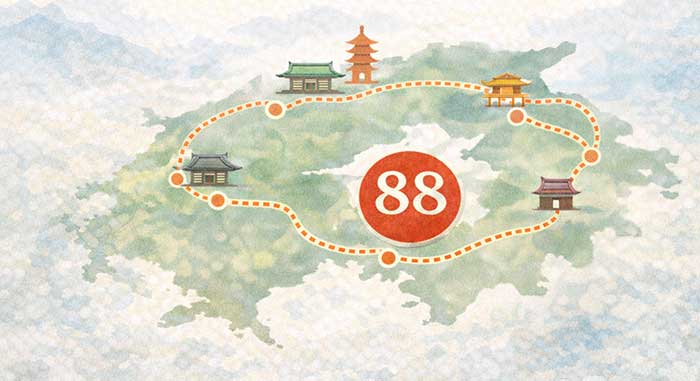
Ohenro is a pilgrimage journey through the 88 temples of Shikoku connected to the spiritual training of Kukai, also known as Kobo Daishi.
As you can see, people take part in Ohenro for many different reasons—prayer, remembrance, life transitions, healing, or simply a desire to reconnect with themselves.
If you ever visit Shikoku, it may be worth stopping by even one temple for a day trip and experiencing a small part of the pilgrimage for yourself.