Shrine or Temple for Healing Prayer? A Practical Comparison Guide

If that’s where your head is at, you’re far from alone — more people sit with this than you’d think.
When you’re praying for someone’s recovery, getting stuck on “where exactly am I supposed to do this” is normal. Day-to-day, nobody thinks about the difference; the moment it actually matters, you draw a blank.
A family member admitted to the hospital, surgery on the calendar, a long stretch of treatment, the worry about recovery. “Where do I send this prayer so it actually reaches?” — the more seriously you think about it, the more this question lands.
In this article, I’ll lay out the difference and the use-case for shrines vs. temples, narrowed specifically to healing prayer, the way I see it.
- What shrines and temples each look like for healing prayer
- The kami (deities) shrines associate with healing
- Why Buddhist temples are traditionally strong for healing prayer
- How the worship etiquette actually differs
- A situation-by-situation guide for which to pick
- Options when you can’t physically get to either, due to distance or caregiving
Shrine or Temple for Healing Prayer? Comparing the Character of Each
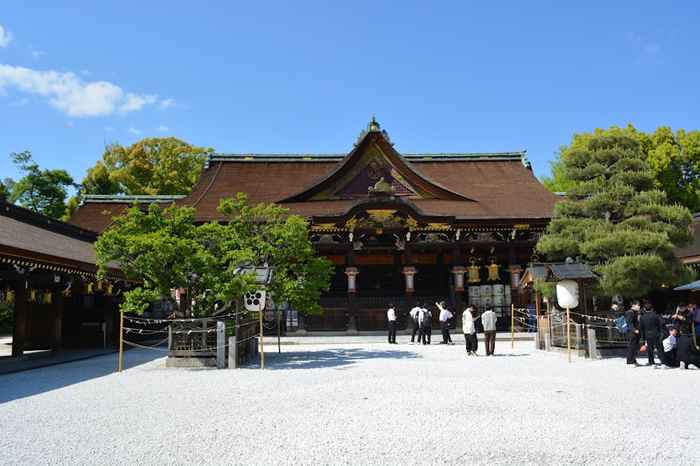
Reality first: both shrines and temples will accept healing prayer requests requests. But traditionally one has been considered “stronger” than the other — knowing that makes the choice easier.
The bottom line: for serious healing prayer, Buddhist temples have traditionally been the stronger option. The reason comes down to the existence of “medicine buddhas” in Buddhism and a thousand-plus-year tradition of healing prayer.
Here’s the at-a-glance comparison.
| Aspect | Shrine (Shintō) | Temple (Buddhism) |
|---|---|---|
| Healing tradition | Some medicine-related kami | Yakushi Nyorai (the medicine buddha) at the center |
| Key figures | Sukunabikona, Ōkuninushi | Yakushi Nyorai, Kannon Bosatsu |
| Representative places | Ōmiwa Jinja, Sukunahikona Jinja | Yakushiji, the Shikoku 88 |
| Worship form | Two bows, two claps, one bow | Hands clasped, one bow (no claps) |
| Relationship with death | Death = impurity; no visits during kichū | Memorial after death is part of the practice |
| Seriousness | Better for everyday, local prayer | Better for serious, turning-point prayer |
With that table as the starting frame, let me go deeper into each side.
What shrines are good at for healing — and the kami involved
Shrines do have kami associated with healing. Plenty of folks assume “you can’t pray for healing at a shrine,” but the tradition actually runs deep.
Here are the medicine-related kami worth knowing.
- Sukunabikona-no-Mikoto: kami of medicine and hot springs
- Ōkuninushi-no-Mikoto: the kami who treated the white hare of Inaba — a healing kami
- Ōmononushi-no-Kami: kami of warding off epidemics
- Kotoshironushi-no-Kami: son of Ōkuninushi, associated with health
- Amaterasu at Ise Jingū: takes general health prayers as well
Especially shrines that enshrine Sukunabikona, like Sukunahikona Jinja in Osaka, have been famous as healing-prayer destinations for centuries — the pharmaceutical industry still maintains a strong connection there.
When you pray for healing at a shrine, the focus is on “recovery from illness in this life.” The idea is that the kami support the health of someone living right now.
The scene of a family at a shrine praying “that grandfather recovers quickly” is everyday, all over Japan. Shrines have always functioned as the place of everyday prayer — that’s the historical role.
Why Buddhist temples are traditionally strong for healing prayer
On the other side, temples house the “medicine buddhas” of Buddhism — and that’s why they’ve been considered the stronger pick for healing prayer historically. The reasons sit deep in the Buddhist worldview.
Here’s why temples are considered strong for healing.
- Yakushi Nyorai exists: Buddhism has the explicit concept of “the buddha who oversees medicine”
- Kannon Bosatsu’s compassion: a wider prayer for relief from suffering
- The chanting tradition: the Heart Sutra and Yakushi Sutra recited as prayer
- Pilgrimage history: routes like the Shikoku 88 with a thousand-plus years of prayer
Yakushi Nyorai in particular is positioned squarely in Buddhism as “the buddha who heals.” Also called “Yakushi Rurikō Nyorai” — the name itself carries the meaning of medicine.
Yakushiji in Nara, Ninnaji in Kyoto, and many of the Shikoku 88 temples have Yakushi Nyorai as their honzon (main object). For serious healing prayer, going to a Yakushi Nyorai temple is the traditional pick.
The Shikoku 88 in particular is a place that absorbs healing prayer at the scale of all 88 temples. Not just one site — praying along a thousand-year-old pilgrimage route as a whole carries serious weight.
For more on the Shikoku-88-based daisan service service, “How daisan delivers healing prayer through the Shikoku 88” goes deeper. Worth reading if you’re considering serious healing prayer.
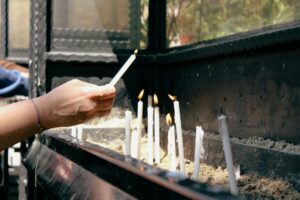
How the worship etiquette differs between shrines and temples
For healing prayer, the etiquette differs sharply between shrines and temples. Getting it wrong is awkward, so worth knowing.
Here’s the side-by-side.
| Stage | Shrine | Temple |
|---|---|---|
| Entrance | Bow once at the torii | Bow once at the sanmon |
| Purification | Left hand → right → mouth → left | Same form is fine |
| Path | Center is for the kami; walk on the side | Walk on the side too |
| Worship | Two bows, two claps, one bow | Hands clasped, one bow (no claps) |
| Incense | Not used | Light incense as part of prayer |
| Kichū period visits | Avoid (until 49-day mochū ends) | Fine — temples are also a memorial space |
The single most important detail is “clap or not.” Accidentally clapping at a temple is the classic mistake. For prayer to a buddha, hands quietly clasped is the correct form.
If you want to go more formal, requesting an official prayer (kitō) from a priest or kannushi is on the table. At temples that’s “goma kitō” or recitation of the Yakushi Sutra; at shrines it’s “seishiki sanpai” — both deeper than a casual visit.
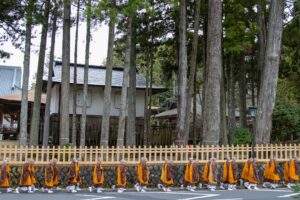
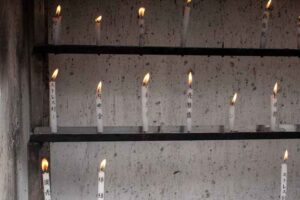
Shrine or Temple for Healing Prayer? A Use-Case Guide
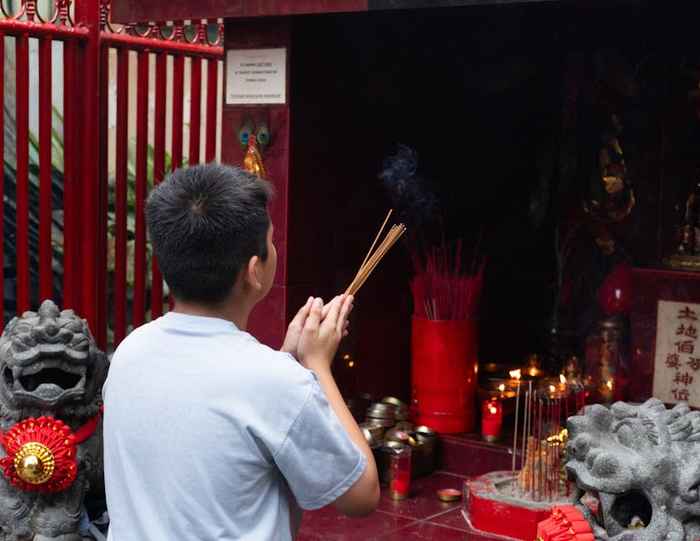
“So which do I actually pick.” Settling it by situation is the most useful frame. The right answer shifts depending on context.
Let me work through it.
The decision criteria by content and situation
Healing prayer has fine-grained variation too — the right place shifts with the specifics. Here’s a simple decision matrix.
| Situation | Shrine | Temple | Note |
|---|---|---|---|
| Everyday health prayer | ◎ | ○ | The local ujigami is plenty |
| Mild ailment / quick recovery | ◎ | ○ | The local shrine works |
| Illness prevention / wellness | ◎ | ○ | Sukunahikona-line shrines, etc. |
| Chronic condition recovery | ○ | ◎ | A Yakushi Nyorai temple, seriously |
| Pre-surgery prayer | ○ | ◎ | Reaching to the buddhas’ compassion |
| Family member fighting illness | ○ | ◎ | Long stretch — deeper prayer fits |
| During kichū (within 49 days) | × | ◎ | Shintō impurity rule — go to a temple |
| Serious turning-point prayer | △ | ◎ | Sacred routes like the Shikoku 88 |
The rough principle: “light / everyday” → shrine; “serious / long-haul” → temple. Use that as the axis and let the situation tune the pick.
If “a family member is hospitalized long-term with a serious illness” describes the situation, serious temple-based prayer fits the color of the moment. The Buddhist framework of compassion sits well with prayer that’s going to last.
A common pattern: “someone whose family member is being admitted first prays for everyday safety at the local shrine, then requests a serious healing kitō at a temple.” Combining both isn’t unusual at all.
For prayer when the family member is in the hospital, “How to send ohenro daisan to a hospitalized family member” works through the choice in detail.
What to do when you can’t get to either
You want healing prayer, but distance, caregiving, your own health mean you can’t physically make it to a shrine or temple. Plenty of folks land here.
Here are the options.
- Asking family or relatives: someone who lives nearby goes in your place
- Mailed-in prayer requests: send the prayer fee to the temple/shrine; they perform the prayer
- Online prayer: remote prayer services have been spreading
- Ohenro daisan service: have someone pray on your behalf at the Shikoku 88
- Praying at home: hands clasped at the family altar or in front of a photo
For serious healing prayer in particular, daisan along the Shikoku 88 has been getting more attention. Prayer to Yakushi Nyorai or Kannon Bosatsu delivered at all 88 temples — a large-scale prayer.
The Shikoku 88’s healing prayer comes through the route Kobo Daishi (Kūkai) opened in the 9th century. Over a thousand years of prayer-history, with the “dōgyō ninin” idea (walking with Kobo Daishi) carrying the prayer.
If “I want to pray seriously for a family member fighting illness, but caregiving keeps me from leaving home” describes the situation, daisan delivers the 88 temples’ prayer without you having to leave the house.
For broader guidance on choosing a provider, the complete ohenro daisan guide lays out the criteria. Worth a look before deciding.
FAQ on Choosing a Shrine or Temple for Healing Prayer
- For healing, is the “right” answer a shrine or a temple?
- If a family member just passed away (within 49 days), where should I pray for healing?
- What’s the main honzon for temples strong on healing?
- Which shrines are famous for healing?
- What if distance or hospitalization keeps me from going at all?
Send Prayer for Recovery From the Place That Best Fits

Healing prayer takes on a different color depending on where it’s offered. Everyday health at a shrine; serious healing at a temple — that’s the traditional split.
There’s no rule that locks you into one. Pick along family situation and how you feel, and that’s enough.
- Healing prayer is accepted at both shrines and temples
- Serious prayer leans toward Buddhist temples (especially Yakushi Nyorai)
- During kichū, skip shrines — temples are fine
- If distance or caregiving keeps you out, daisan exists as an option
- The Shikoku 88 is a healing-prayer site with a thousand years of history
If you’re sitting with “I want to pray seriously for my family, but I can’t move” — Ohenro Gift Bin, walking the 88 temples to deliver prayer, is one option to consider.
A real nōkyōchō and a record of the pilgrimage land as proof of the healing prayer. Place it on the family altar, and the whole household can share the prayer.
If you’re thinking about serious healing prayer, the move is to talk through prayer content and timing with a provider first. Confirm pricing, the process, and what they cover, then move forward only when you’re convinced.
For pricing, the mechanics, or whether shrine vs. temple fits — anything you want to ask, please reach out via the plan and LINE consultation page. Even just a question is fine.
“Which fits our family situation?” “Where do I start with serious prayer?” — specific questions get straight, honest answers, one at a time. Moving forward only when you’re convinced is what we want too.
Recovery for the people you love deserves prayer from the place that best fits. Honor what shrines do, honor what temples do, and pick the form of prayer that lines up with the situation.
▼Related reads
- Healing Prayer at the Shikoku 88: How Ohenro Daisan Delivers It
- Sending Ohenro Daisan to a Hospitalized Family Member
- Shrine vs Temple for Ganakake: Comparing Benefits, Etiquette, and How to Choose
![[Ohenro]Shikoku Pilgrimage Proxy Service: Costs and How to Choose a Trusted Provider](https://ohenro-gift.com/en/giftohenro369/wp-content/uploads/2026/03/agency_thumb-300x200.jpg)