Letting Go of Helplessness: Meaningful Ways to Show a Hospitalized Family Member You Care

A family member gets hospitalized.
From the moment you hear the news, something settles in your chest and refuses to move.
That feeling — “I want to do something for them, but I can’t” — is more common than people let on. Plenty of us carry it quietly.
Maybe you live far away, or your job won’t bend, or you’ve got small kids at home. The specifics differ, but the fact that’s left behind is the same: you physically can’t be there next to them.
And what grows out of that is helplessness.
This article is about sitting with that helplessness without letting it flatten you — and about the quiet options you still have for sending something real, even from far away.
- What’s actually underneath the helplessness you feel when a family member is in hospital
- A clean way to sort through the options for reaching them
- Why prayer across a distance ends up being a real form of support
- What you can still do today so you don’t look back later wishing you had

The Helpless Feeling Is Natural — Start by Sorting Out What You’re Actually Feeling

When a family member lands in the hospital, your head doesn’t just go to “worry.”
Underneath all the worry, there’s usually something quieter — a voice saying “I’m not doing anything for them” that you probably haven’t told anyone about.
Before you try to fix it, let’s unpack what that helpless feeling actually is.
Even from Far Away or a Packed Work Schedule, That “I Can’t Do Anything” Feeling Still Hits
When you want to do something for a hospitalized family member, the real-world walls add up faster than people admit.
Any of these sound familiar?
- Your hometown or the hospital is far away, so you can’t just drop by
- Work makes weekday visiting hours basically impossible
- You’ve got small kids and can’t leave the house for long stretches
- Your own health isn’t great and long travel wipes you out
- The hospital has visitor restrictions, so seeing them at all is limited
Every one of those reasons is not your fault.
And yet, some corner of your head keeps whispering that you’re failing them. People who care a lot tend to carry this the hardest.
Helplessness Is Just the Gap Between “What You Want to Do” and “What You Can Do”
Helplessness has a pretty simple shape when you actually look at it.
It’s the space between “what I want to do for them” and “what I’m able to do right now” — and the gap between those two feels unbridgeable.
Which means, flipped around, that the helpless feeling itself is proof that you care about this person a lot.
When you miss that framing, the helplessness turns on you and you start beating yourself up.
“I’m useless” isn’t a helpful thought. “Let me find something I can actually do” is. Just nudging the frame one step over takes a surprising amount of weight off.
Start by letting yourself feel helpless without punishing yourself for feeling it. Everything useful starts from there.
When you’re deep in the helpless feeling, your brain tends to fill up with everything you can’t do.
But if you zoom out a bit, there’s usually a surprising amount you still can do.
Thinking of them every night before bed. A quick phone call. A short message checking in. A photo sent at random.
Any one of those looks small. But stacked up over time, they land quietly with the person in that hospital bed.
What You Can Actually Do for a Hospitalized Family Member — A Clean Menu of Ways to Show You Care
Once you’ve let yourself feel the helplessness, the next step is asking “what can I actually do”.
The big thing here is to not get stuck on one single method.
Can’t visit? Try a non-visit route. Can’t send something physical? Words and presence still count. The menu is wider than people realize.
Visits, Gifts, Contact, Prayer — Picking What Fits Your Distance and Their Situation
The ways of reaching a hospitalized family member break down into four buckets.
There’s no single correct answer. You pick the one that fits your situation and their condition.
If the hospital has strict visitor rules, visits are off the table anyway. If your family member is exhausted, a quiet message can land better than any gift. If they’re doing better, a family photo or a short voice note can be a real lift.
What matters is thinking from their side, not yours.
Let me break the decision down a little more concretely.
- Their condition: Recovering, or mid-treatment?
- Your distance and bandwidth: How much can you physically and realistically do?
- The depth of the relationship: Immediate family, extended family, old friend — these all shift what fits
Holding those three in mind makes the right shape of outreach for you easier to see.
For someone in the thick of treatment, a quiet letter can carry more than a noisy visit. For someone in recovery, a family update or a photo can be pure oxygen.
Don’t chase a single right answer. Flex to what fits them and what fits you. That’s the whole game.
Sending an Object Isn’t the Only Answer — The Other Ways Love Travels
When people hear “hospital visit,” their first instinct is “what do I bring?”.
But an object isn’t always the answer.
Hospital rooms are small. Food might be restricted. A lot of hospitals won’t even allow fresh flowers. The gift you carefully chose can quietly become a burden.
Physical objects aren’t the only currency here.
Words, time, attention, prayer. Every one of those is a legitimate gift that reaches the person.
For someone who’s deep into treatment, the feeling that “someone is watching out for me” can become the kind of support no pharmacy stocks.
Giving an object isn’t wrong, obviously.
It’s just worth knowing you have options outside of objects, because the moment you know that, the surface area for reaching them widens a lot.
A letter can be re-read after discharge. A photo can sit on the nightstand. A recorded message from family can be quietly replayed at 2 a.m. when the room gets too quiet.
Both things that last physically and things that don’t are real gifts.





Distance Doesn’t Block the Message — Sending Prayer to a Hospitalized Family Member

So far we’ve walked through ways to reach them.
The last option I want to put on the table is prayer.
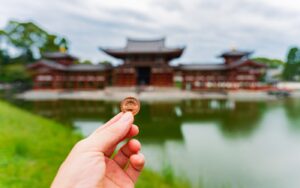
Japan has a long tradition of praying for family members you can’t be with. Even without seeing them, even across distance, the belief is that your intention still reaches them.
Why Prayer from Far Away Actually Becomes a Real Support for the Person in the Hospital
You might be thinking, “If I just pray in my head, they’re never going to know.”
But if you actually talk to people who’ve been hospitalized, they’ll often tell you something surprising.
A hospital room is a lonelier space than most people expect.
Waking up at 2 a.m. Waiting for test results. Staring at the ceiling with nobody in the room.
In those hours, the quiet sense that “someone out there is praying for me” lights something small in the chest.
That’s a kind of support no physical object really replicates.
People who’ve been through long hospital stays often describe a specific moment when they realized their family was actively doing something for them — and how close they came to tears.
There are people who say that knowing their family was physically moving on their behalf was the moment they turned toward their treatment with real resolve.
Sometimes, the intention itself moves something that an object can’t. That kind of shift really does happen in a hospital room.
Prayer isn’t something you force on anyone, of course. With respect for their beliefs and feelings, just holding them in your mind quietly is already a meaningful act.
Daisan: Shaping Prayer into Something You Can Actually Hand Over via Shikoku’s 88-Temple Route
Japan has an old practice called daisan — proxy pilgrimage pilgrimage.
Daisan means someone visiting a temple or shrine on behalf of on behalf of another person who can’t physically make it. It’s been around since the Heian period — a long, quiet thread of prayer-delivery in Japanese culture.
By the Edo period, there were literal community groups called daisan-kō organized specifically for sending someone to a faraway sacred site on behalf of people who couldn’t travel. That’s how embedded it was in daily life.
The version most recognizable today is Shikoku’s 88-temple proxy pilgrimage.
- Someone actually walks the route Kobo Daishi opened 1,200 years ago — the pilgrimage isn’t symbolic, it’s physical
- The principle of dōgyō ninin (“two traveling as one”) means Kobo Daishi is understood to carry the prayer with them
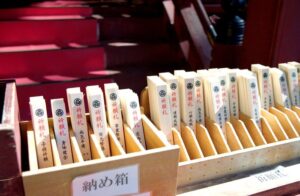
- Prayers are offered at every temple on the route, and you receive a nokyocho — a record that stays in the family’s hands
Prayer is, by definition, invisible.
Which is why a lot of people quietly wonder, “Did it actually land?”
A Shikoku proxy pilgrimage gives you an answer to that in a very Japanese way: the nokyocho comes back as physical proof that the walk and the prayer actually happened.
Delivering a nokyocho alongside the prayer, straight to the hospitalized family member, is an option most people have never heard of. I just want it to exist in your peripheral vision.
That said, proxy pilgrimage is just one form prayer can take.
Visiting a nearby shrine, lighting a candle, or simply holding them in your thoughts at night — all of those are real prayer too.
But if the shapelessness has been bothering you, and you want something tangible to hand to them, daisan — one of the oldest threads in Japanese spiritual culture — is worth keeping in mind.
If you want to go deeper, I wrote a more focused piece on proxy pilgrimage specifically for hospitalized family members — have a look at proxy pilgrimage for a hospitalized family member when you have a quiet moment.






Common Questions About Caring for a Hospitalized Family Member from Afar
- I live far away and can’t visit my hospitalized family member often. What can I actually do?
- I want to send something, but I don’t know what a hospital patient actually wants.
- I keep beating myself up for “not doing anything.” How do I work through this?
- Is it religiously weird to ask for a proxy pilgrimage for a hospitalized family member?
- When’s the right time to do something like this?

Let Go of the Helplessness and Send What You Can to Your Family Today

We’ve walked through the helpless feeling that comes with having a hospitalized family member, how to sort through it, and the different ways of actually reaching them.
The part that matters: not staying frozen in the helplessness, but picking something you can do and actually moving once.
- The helplessness you feel is the flipside of how much you love this person
- There are four broad lanes for reaching them: visits, gifts, contact, prayer
- Objects aren’t the only answer — words and presence are gifts too
- Prayer crosses distance, and that’s part of a long Japanese tradition of caring from afar
- Daisan — Shikoku proxy pilgrimage — is a thousand-year-old way of turning that prayer into something tangible
If you want to put your prayer into physical form and send it to your family member, Ohenro Gift is here for that.
We carefully take each family’s intention, walk Shikoku‘s 88-temple route in person, and carry that prayer to every stop along the way. What returns to your family is the nokyocho — a physical record of the walk and the prayer.
Feel free to just tell us what’s going on.
- “I want to understand how this works”
- “I want to check if this is appropriate for our family situation”
- “I haven’t decided anything yet — I just want to talk it through”
Any of those are fine. No pressure — we’ll meet you where you are, quietly.
Don’t stay inside the helpless feeling. Choose the time where you start moving in a form that actually fits you.
Each small action looks small on its own, but stacked up, they genuinely become the support your family leans on.
The fact that you want to do something for them is already an enormous gift. Adding one small step on top of that is enough.
My hope is that that one step becomes part of a family memory you never end up regretting.
![[Ohenro]Shikoku Pilgrimage Proxy Service: Costs and How to Choose a Trusted Provider](https://ohenro-gift.com/en/giftohenro369/wp-content/uploads/2026/03/agency_thumb-300x200.jpg)