
Special Offerings for Japanese Memorial Services: Picking Unusual Hōji and Hōyō Gifts That Actually Land
You’re not alone in feeling that way.
The standard offerings for hōji (Japanese Buddhist memorial services) tend to be “sweets, fruit, incense, or candles.” But after attending several of them, the same items start to feel a bit underwhelming.
That said, picking something unusual carries the worry of “will this come off as inappropriate?” or “how will the bereaved family receive it?” Memorial services are sensitive contexts — that worry is natural.
In this article, I’ve put together special and unusual offering options for hōji and hōyō (memorial rites), from the perspective of the attendee.
- Why standard offerings start to feel insufficient
- What conditions actually make the bereaved family appreciate an offering
- 3 categories of unusual and special offerings
- The new approach of “making prayer itself the offering”
- Daisan (proxy pilgrimage) as an offering option
For Anyone Stuck on Hōji Offerings — Why “Beyond the Standard” Is Becoming the Norm
For hōji and hōyō offerings, picking something beyond the standard is becoming a noticeable modern trend. Sweets and fruit aren’t bad in themselves, but plenty of attendees feel uncomfortable when the same items keep stacking up, in my view.
Behind this shift, both the attendee and the bereaved family’s circumstances have changed.
With nuclear families and aging populations becoming the norm, the physical and emotional burden on bereaved families tends to be larger than it used to be. The way offerings get chosen reflects that backdrop.
Beyond sweets and fruit — alternative offerings
The reason standard sweets and fruit are getting passed over: “too many of them pile up to actually use.” A memorial service draws several relatives and acquaintances, so the same items duplicate easily.
Some bereaved families end up looking at a stack of offerings they can’t deal with and feel conflicted. The kindness someone meant ends up reshaped into a different burden — that pattern shows up surprisingly often.
Let me lay out what’s happening on the family side.
- Sweets duplicate: Quantity that won’t be eaten before the expiration date piles up
- Fruit goes off: Doesn’t keep, and disposing of it becomes its own problem
- Incense and candles: More than can be used up — sits in storage
- Storing flowers: Even altar flowers get hard to organize at high volume
- Where to put it all: Sorting things out after the service takes time
So the standard offerings, despite the giver’s good intent, can quietly become a burden on the bereaved. The more attendees know this, the more they look for alternatives.
Especially at 3rd anniversary or 7th anniversary memorials, the attendee count rises. A landscape where 10 boxes of the same sweets and 5 boxes of incense line up gets the family thinking “we appreciate it, but…”
That said, picking something too out-of-left-field carries the risk of “that’s not appropriate for a memorial service.” Balance is what makes this such a tough pick.
The conditions for offerings that actually delight the family
Offerings that bereaved families actually appreciate share a few common conditions. Whether you can balance “special” and “not inappropriate” is the deciding factor, in my view.
Let me organize the conditions.
- The feeling for the deceased comes through: The reason for choosing it is clear, and the heart shows
- Doesn’t burden the family: Storage, disposal, return-gift logistics stay light
- Doesn’t duplicate other offerings: Differentiated from standard items
- Fits the dignity of a memorial service: Not too unusual — has class
- Something that stays in memory: Has elements that linger after the service
Offerings that meet all 5 conditions tend to be ones that prioritize “spiritual value” over “material value”. The image is one where the feeling sits at the center, more than the object itself.
If you’re someone reaching for “I want to pick a special offering,” you’re already conscious of at least one of those 5 conditions. From there, knowing the actual concrete options is what really opens up your choices, in my view.
More than fanciness, it’s the background of “chose this for the deceased” that stays with the family. The thickness of the feeling matters way more than the price tag, in my view.
For example: pick a book the deceased loved, or something tied to a hobby they had. Or a regional specialty from a place they were connected to. An offering that reflects “their personality” leaves a deeper impression than the standard items can.
For the bereaved family too, the moment they sense “this offering was chosen with the deceased in mind” is special. The difference from a formal offering shows up exactly in this kind of background.
3 Categories of Unusual and Special Offerings for Hōji and Hōyō
Unusual and special offerings can be sorted into 3 main categories. They have different characters, so pick based on your relationship with the deceased and the family.
Let me walk through each category in order.
The 3 categories sit on different axes: “form,” “act,” and “utility.” Any category works at a memorial service, but the relationship with the deceased and family is the main judgment factor when choosing.
Commemorative type that remains as form, as proof of remembering the deceased
Commemorative-type offerings are the category of giving “something that stays as form” as proof of remembering the deceased. They don’t just get used at the service — they keep going as something the family holds onto.
Specific items include:
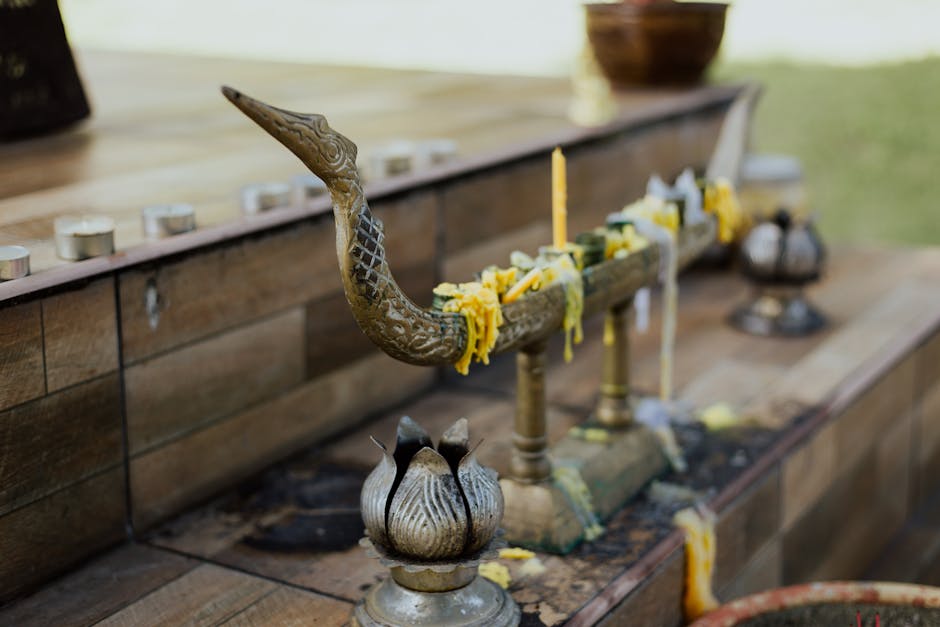
- Engraved Buddhist altar items: Incense holders or bells with the deceased’s name or kaimyō (posthumous name)
- Photo albums or memorial books: A volume compiling photos from the deceased’s life
- Handwritten memorial messages: Memories written down by attendees
- Preserved flowers: Altar flowers that don’t wilt and stay on display long-term
- Japanese-style objects: Small ornaments or incense stands for the family altar
The strength of commemorative type: “after the memorial service ends, the family can still pick it up and remember.” Holding non-disposable elements becomes the value of a special offering.
In particular, photo albums and memorial books tend to gain value over the years. Across 3rd, 7th, 13th anniversary milestones, they get revisited multiple times.
For engraved altar items, the trick is to match the size and style of the family’s actual altar. Quietly checking ahead of time helps you pick something that fits perfectly.
Experience-and-prayer type, offering that delivers feeling rather than objects
Experience-and-prayer type is the category of giving “acts” or “prayer” as offerings, rather than physical things. This might be the most spiritually grounded form of offering.
It maps onto the traditional Japanese form of memorial practice that’s been in place for centuries.
- Sutra recitation request: Asking the family temple (bodaiji) to chant for the deceased
- Goma fire ritual request: A prayer ritual at Shingon-affiliated temples
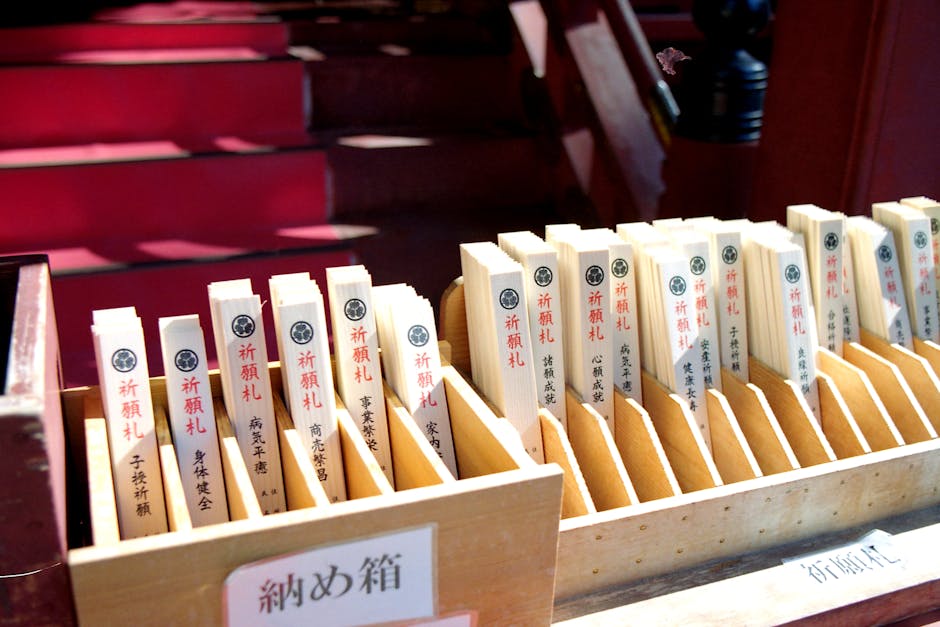
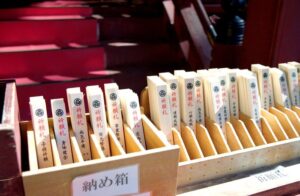
- Toba memorial offering: Dedicating a wooden toba plaque inscribed with the kaimyō
- Pilgrimage / daisan: Delivering prayer for the deceased in pilgrimage form
- Recorded sutra chanting: Professional monk’s chant captured as video
The biggest feature: “the act itself becomes the offering,” not an object. It’s an expression of belief that formless prayer truly reaches the deceased.
In particular, daisan is a traditional offering form going back over a thousand years in Japan. I’ll cover it more in detail later, but as an offering from an attendee, this is a deeply meaningful category, in my view.
“Sutra recitation requests” and “toba offerings” go directly through the family temple — traditional forms. Relatives with established temple relationships tend to choose these. On the other hand, pilgrimage and daisan happen at distant sacred sites, which is what makes it easier to convey individual attendees’ feelings.
The strength of experience-and-prayer type: “the act itself stays as record” instead of getting consumed as an object. It stands out at a memorial service for that reason.
Practical type, special gifts that don’t burden the bereaved family
Practical type is the category of giving items the family will actually use, while bringing a sense of “special.” It’s offerings chosen with the family’s life after the memorial service in mind.
Especially with relatives close to the deceased, this category lands well — the consideration shows.
- Rice vouchers, catalog gifts: Family can use them when they need to
- Premium tea or coffee: Useful when guests visit
- Old-shop wagashi (Japanese sweets): Standard but bumped up in quality
- Towels, bedding, daily-use items: Practical-priority choice
- Gift certificates: Flexibility for the family to decide
Practical type emphasizes “usefulness over flashiness.” Especially for the deceased’s spouse or co-living family, it can become small daily support.
“Making Prayer the Offering” — Daisan as a Choice
Within the 3 categories, choosing daisan as a “prayer-type” offering has been quietly increasing in recent years. Giving the act rather than an object — a slightly special option, in my view.
For folks unfamiliar with the term “daisan,” let me lay it out carefully.
What is daisan? Its meaning and role in the memorial-service context
Daisan means someone visits or makes a pilgrimage to a temple or shrine on your behalf. It’s a traditional form of religious visit that’s been rooted in Japan for over a thousand years.
In the hōji context, the attendee requests a daisan for the deceased and gives the record of that pilgrimage as the offering.
The reason daisan works as a hōji offering: “in a place of remembering the deceased, prayer can reach from elsewhere too.” The thinking is that even if you couldn’t attend the service, you can deliver prayer through the pilgrimage form.
For the meaning as tsuizen-kuyō (continuing memorial care), why daisan is chosen for tsuizen-kuyō goes deeper.
In the Edo era, there was a system called “Ohenro-kō” — a culture where villages pooled funds to commission a pilgrimage. Daisan has functioned as memorial care from individual attendees for centuries.
Today, the individual booking form is the norm, but the underlying idea of “entrusting prayer to someone” hasn’t changed since then. Choosing daisan as a hōji offering sits naturally in that lineage, in my view.
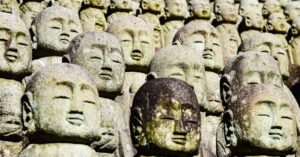
How the bereaved family receives daisan when given as an offering
When daisan is given as an offering, the bereaved family tends to receive it as “special memorial care”. The thickness of prayer that objects can’t express, they really do feel.
Let me organize the concrete elements they receive.
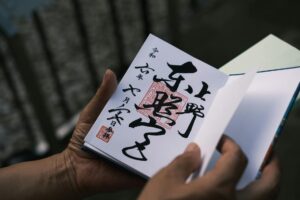
- A real nokyocho: A record with stamps and calligraphy from all 88 temples
- Pilgrimage report: Photos, videos, and prayer reports from each temple during the trip
- Byakue (white robe): Pilgrimage robe dedicated under the deceased’s kaimyō
- Records of dedication: Proof that the pilgrim prayed on-site
- The giver’s feelings: A letter explaining why you chose this
When these arrive, they stay with the family as “memorial care with thickness no other offering has.” Objects get consumed, but the pilgrimage record keeps remaining at hand.
In particular, the nokyocho is a one-of-a-kind record, hand-brushed at each of the 88 temples. Opening it up at the memorial service can draw the attention of every other attendee. The realization that “this person did this much for the deceased” lands as something visible and tangible.
Some bereaved families place the nokyocho on the butsudan, others keep it in the living room and look at it daily. A physically remaining record of prayer becomes a kind of emotional support for the family well after the memorial service ends.
A. It’s not disrespectful at all. The Shikoku pilgrimage is an open route that doesn’t ask about sect, and daisan is received as a universal act of remembering the deceased. Adding a brief letter saying “I prayed for the soul of the deceased” makes the feeling come through more clearly.
For memorial care for the deceased generally, why daisan is chosen for memorial care of the deceased is also worth referencing. Worth checking the concrete meaning in the memorial-service context.
The motivations of folks who choose daisan as a hōji offering have a common pattern. “There was a special relationship with the deceased,” “standard offerings feel insufficient,” “I want to deliver prayer in a form that genuinely reaches.” These three feelings sit in the background.
For the deceased too, having someone dedicate their name at all 88 temples is a special experience. Formless prayer gets converted into the tangible form of a nokyocho and delivered. That’s the core of what daisan-as-offering really is, in my view.
For specifics on how the proxy service works service works, please confirm the complete guide to Ohenro proxy services.
![[Ohenro]Shikoku Pilgrimage Proxy Service: Costs and How to Choose a Trusted Provider](https://ohenro-gift.com/en/giftohenro369/wp-content/uploads/2026/03/agency_thumb-300x200.jpg)
Common Questions About Hōji and Hōyō Offerings
- If I pick an unusual offering, won’t it stand out from other relatives?
- If I make daisan the offering, when and how do I deliver it?
- What budget makes sense?
- What should I write on the noshigami (gift wrapper)?
- Is it okay to give daisan when the family’s sect differs?
Heart for the Deceased — Pick by Substance Over Form
The reason “special” is being asked of hōji and hōyō offerings is that standard items have started to feel formulaic, in my view. Exactly because objects are everywhere now, offerings where the feeling is visible are what people are looking for.
The 3 categories — commemorative, experience-and-prayer, practical — pick the one that fits your relationship with the deceased and the family.
- Standard sweets and fruit duplicate easily and can become a burden
- Offerings that delight bereaved families are ones where “feeling for the deceased” shows
- Pick from the 3 categories (commemorative / prayer / practical)
- Daisan is a traditional offering form going back a thousand years
- The thickness of feeling matters more than the form
Standard offerings aren’t bad in themselves. But if “I want to pick something special, oriented toward the deceased” describes you, there’s always an option that meets that feeling. The 3 categories I covered today should be a good starting point.
The feeling of remembering the deceased can’t be measured by how fancy the object is. The background of “I chose this for them” is what really makes the value of an offering, in my view.
A memorial service is a milestone that repeats. Across the 1st, 3rd, 7th, 13th anniversaries — being able to put “the deceased’s character” or “feeling-driven background” into each offering. That becomes the strength to carry the deceased forward across generations.
For folks with a special relationship with the deceased, there’s an offering “only you can pick.” Instead of standard formula items, why not consider your own way of choosing?
The feeling of remembering the deceased is different for every attendee. By choosing an offering loaded with your unique feeling, the memorial service space gets gradually warmer. A space where heart-to-heart exchange beyond formality happens.
If you’re stuck, start by asking “what would the deceased be glad about?” More than fanciness or rarity, starting offering selection from that question is what reaches the family in the end. A pause to think is the starting point of a special choice, in my view.
If “I want to give a tangible-prayer offering” describes you. Ohenro Gift Bin, which walks Shikoku’s 88 temples to deliver prayer, is one option. The real nokyocho and pilgrimage records get delivered to the bereaved family.
For pricing, structure, how to time it for a memorial service, anything that comes up. Reach out via the plans and LINE consultation page. Asking is fine — no commitment needed.
A. From booking to delivery, it generally takes 45–60 days. Reaching out 3 months before the memorial gives you margin. We can adjust flexibly to fit your schedule — please get in touch.
For folks feeling “had a special connection with the deceased” or “standard offerings aren’t quite enough,” we’d love to respond in a form that fits the feeling. Just message us casually.
▼ Related reads
- Honest Memorial Care for the Deceased: Why Ohenro Daisan Is Chosen for the 49th Day and 1st Anniversary
- Tsuizen-Kuyō Through Ohenro Proxy: Delivering Prayer to the Deceased Across Shikoku’s 88 Temples
- Complete Guide to Ohenro Proxy Services — Pricing, Process, and How to Pick a Trustworthy Provider